
ClearSkies Endpoint Threat Monitoring and Response
See the whole endpoint, not just the malware.

Full behavior
Process lineage, scripts, files, registry and network, so an attack is recognized by what it does.
Real time
A malicious sequence is classified and contained at machine speed, before it spreads.
Proportionate action
Every verdict carries a band, so automation fires only on high certainty.
Why a behavioral agent rather than a signature-first one
Every serious intrusion eventually reaches an endpoint, and a signature-first tool sees only the part of that story it already recognizes. ClearSkies iISOC ETMR monitors the behavior of endpoint processes, files, users and network activity, turning the device from a place attacks land into a high-fidelity detection sensor.
Threat actors operate on the endpoint at every stage of an intrusion. Payloads are repacked to evade signatures, living-off-the-land techniques abuse the operating system’s own trusted binaries so nothing malicious is ever written to disk, and lateral movement rides legitimate administrative tooling.
Where the signature-first approach falls short
What ETMR does differently
ETMR runs continuously on every managed device, recording the full behavioral story rather than waiting for a signature match.
It correlates process lineage, file and registry changes, user activity and network connections, evaluates them together against threat intelligence, behavioral models and YARA rules, contains what is malicious, and preserves the complete record.
ETMR alongside the endpoint product you already run
ETMR adds the behavioral layer rather than displacing what is already deployed. The existing product keeps doing what it does well, ETMR catches what it was never built to see, and the TDIR engine correlates both into one picture rather than two queues.
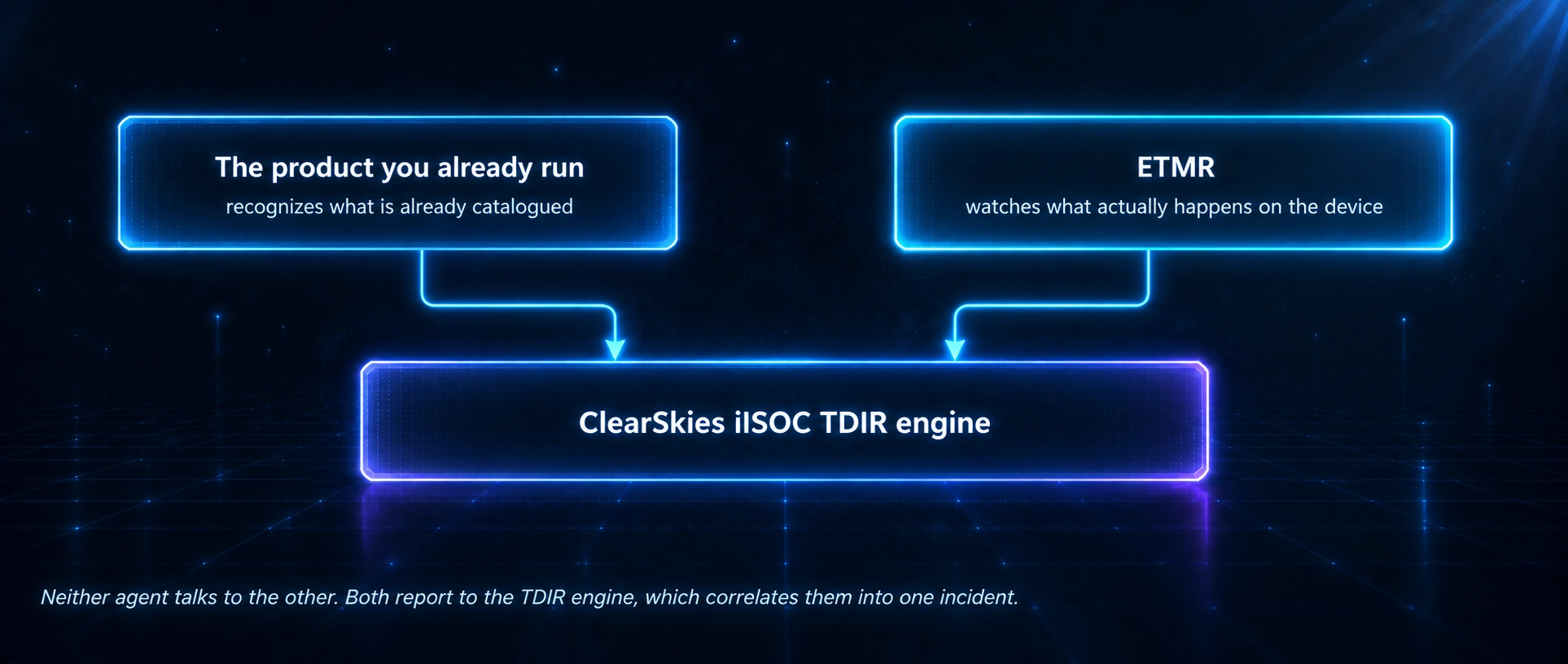
Neither agent talks to the other. Both report to the TDIR engine, which correlates them into one incident.

What ETMR adds
The full behavioral record rather than a log of detections: process lineage with command line and execution context, file and registry change, host-level network behavior including traffic that never reaches a proxy, and memory scanning against YARA rules. None of it depends on the file being recognized.

What the platform adds on top of both
Every ETMR verdict reaches the TDIR engine, where it is correlated with identity risk, external exposure and the verdict on any domain the endpoint tried to reach. Your existing product reaches the same engine through the ClearSkies Marketplace, our catalog of third-party integrations, so both are read together rather than compared by hand.
What sets ETMR apart
Behavior, not signatures
Detection follows what a threat does, so fileless and living-off-the-land attacks are still caught.
Confidence-banded verdicts
Containment fires only on high-certainty threats, so analysts are not reversing false-positive kills on critical systems.
Inline containment
The process is killed and the host isolated in seconds, on the device, limiting blast radius to the first endpoint.
Detection and hardening in one agent
The same agent ranks the missing patches and configurations that would have let the attack in.
What it changes for the security operation
ETMR catches fileless and living-off-the-land attacks that signature engines miss entirely, and contains ransomware and credential theft inline before they spread.
Because every verdict reaches the TDIR engine, a generic connection alert becomes a high-fidelity incident, which lowers mean time to detect and respond and leaves audit-ready evidence for the board and for regulators.

Questions Raised in Evaluation
Do we have to remove the endpoint product we already have?
No. ETMR is designed to run alongside it. The existing product keeps catching what it catalogues, and ETMR adds continuous behavioral monitoring, inline containment banded by confidence, and the full record an investigator needs afterward. Onboarding sets the exclusion policy for both before enforcement is turned up.
What stops ETMR from killing a business-critical process by mistake?
No single signal produces a confirmed verdict. Weighted contributions from several independent detection sources decide the confidence band, and inline containment is reserved for the Confirmed band. Lower bands are contained, flagged or logged according to tenant policy.
How ETMR is licensed and delivered
ETMR is a native add-on to ClearSkies iISOC and is not sold on its own. It is deployed with the platform, licensed by monitored endpoints, and delivered with onboarding, integration and training. Tier structure and commercial terms are confirmed with our team.
See the whole endpoint, not just the malware.
Threats are caught by what they do, not by what they are already known to be.
Request a Demo